July 17, 2026
What Babies and Toddlers Learn in Daycare Ages 0 to 3
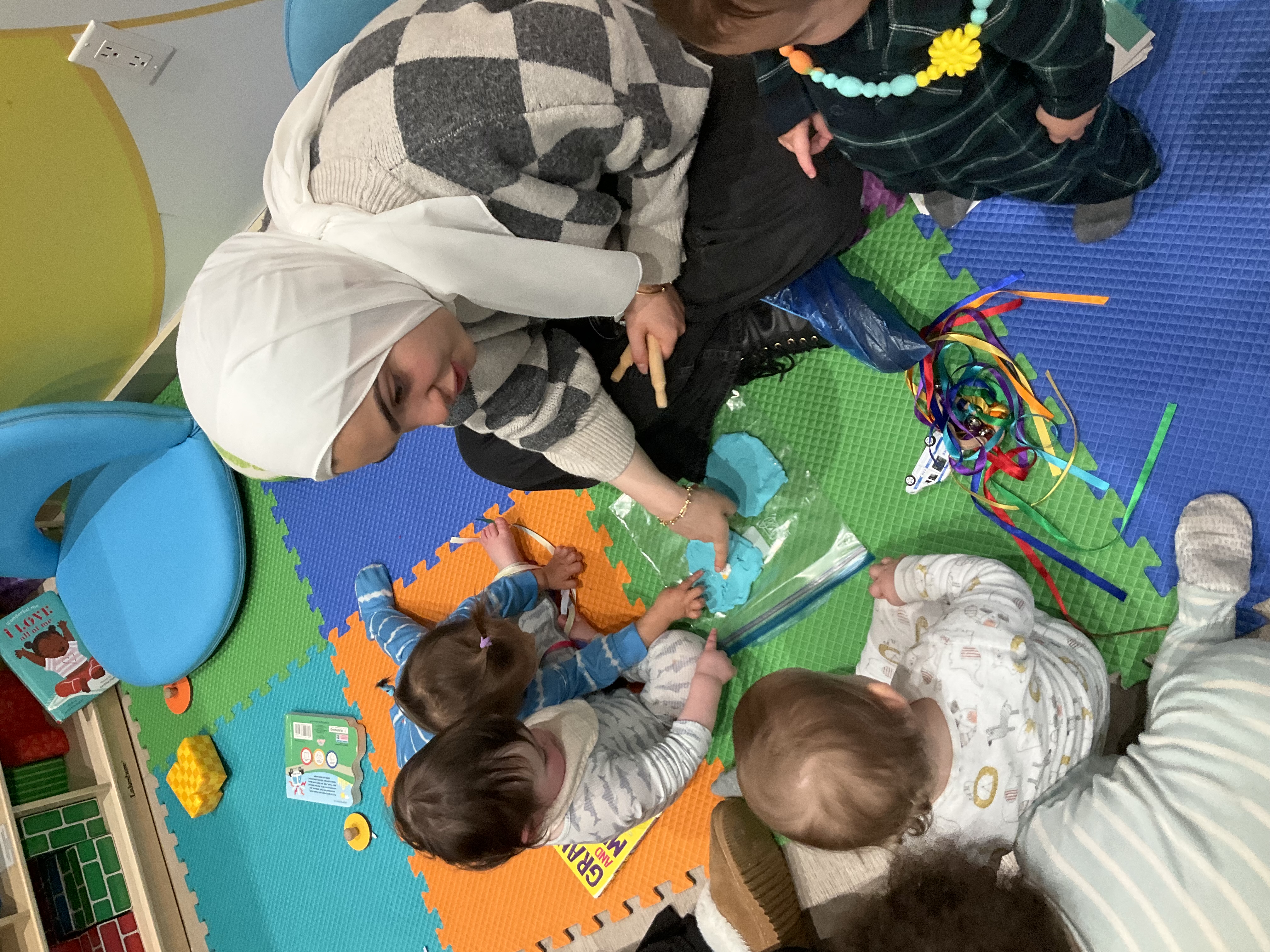
The learning looks like play because it is. But it's designed more carefully than it appears.
Before They Can Walk or Talk, They're Already Learning the Most Important Thing
What babies learn in daycare before their first birthday is not academic content. It is something more foundational: how the world responds to them. A baby who cries and is answered quickly learns that communication works. A baby who reaches for an object and is encouraged to grasp it builds hand-eye coordination alongside trust. A baby who is held, named, and noticed during every small moment is building the neural architecture that language, emotion, and memory will eventually run on.
This is not soft sentiment. The Harvard Center on the Developing Child explains that serve-and-return interactions, the responsive back-and-forth between a caregiver and a baby, are the mechanism through which early brain connections are formed and strengthened. In a high-quality infant classroom, this happens dozens of times per hour, across feeding, tummy time, quiet play, and the transition between activities.
At Playto, the Tiny Cruisers program is built for exactly this age range. The Advanced Early Development and Learning curriculum is structured around caregiver responsiveness, sensory exploration, and the kind of consistent routine that allows babies to predict and eventually understand their environment.
Language Doesn't Start With Words. It Starts With This.
Language development in the first three years is not about vocabulary lists. It begins with sound recognition before birth and expands rapidly through the first year as babies start to distinguish the phonemes of their home language, imitate mouth movements, and babble in patterns that mirror adult speech rhythms. By 18 months most children use around 20 words. By 36 months many have a vocabulary of several hundred words and can speak in short sentences.
A daycare classroom accelerates this naturally when it is designed for conversation rather than just supervision. A teacher who narrates what she is doing while changing a diaper, who names the color of the block, who repeats a toddler's approximation of a word back in a full sentence, is providing what researchers call language scaffolding. The Zero to Three organization calls this "serve and return talk," a conversational pattern that builds vocabulary, grammar, and the confidence to keep trying to communicate.
In the Little Pathfinders program for children ages one to two, and the Young Explorers program for children ages two to three, language development is woven into every transition, activity, and moment of connection throughout the day. Parents can track how their child's communication is developing through the Parental App and Oversight system that Playto uses to keep families connected.
What a Well-Designed Classroom Actually Gives a Child
Infant toddler development has a specific texture. The children who come to Playto arrive from apartments and co-ops in SoHo, Financial District, Hudson Square, West Village, LoHo, Civic Center, Battery Park City, FiDi, Chinatown, Lower East Side, and NoHo. Many have had nannies, au pairs, or home-based care before starting a center program. Others are coming from another borough where a caregiver has moved. Some are starting care for the first time.
What a well-designed infant and toddler classroom gives each of these children is a set of social experiences that home care simply cannot replicate: learning how to be near another child without taking their toy, learning how to wait for a turn, learning how to move through a group activity and still feel seen as an individual. These are not skills taught through lessons. They emerge over months of being in a consistent, caring environment with other very small people.
Research from the American Academy of Pediatrics notes that social interaction in the first year of life, including with peers, builds the foundation for empathy, communication, and emotional regulation. A group care environment where those interactions are guided by trained educators is one of the most powerful early learning investments available to families.
Movement Is Not a Break From Learning. It Is the Learning.
Motor development is learning. When a four-month-old practices tummy time, she is building the shoulder and neck strength she will need to sit, then crawl, then walk. When a ten-month-old pulls to stand at a low table, he is solving a problem using his body. When a two-year-old tries to pour water from one cup to another without spilling, she is doing physics.
In a high-quality infant and toddler program, the physical environment is designed to support these experiments safely. Low climbing structures, sensory materials, soft floors, objects of different weights and textures, water and sand tables, outdoor time calibrated to the season: all of these are part of a thoughtfully designed motor development curriculum. They do not look like traditional school learning, but they are building the body awareness, coordination, and problem-solving stamina that later academic and physical skills depend on.
Playto's Safe and Snug® protocol ensures that this kind of exploratory physical play happens in an environment that has been designed and maintained with infant and toddler safety as the operating standard, not an afterthought. You can review how the Safe and Snug® protocol works before scheduling a tour.
The Skills That Shape Everything Else Start Here, Not in Kindergarten
The social and emotional skills that shape how a child navigates school, friendships, and stress for the rest of their life begin in the first three years. Not in kindergarten. Not in the third grade. Now, in the quality of daily care your child receives between birth and age three.
These skills include: the ability to recognize and name basic emotions, the capacity to tolerate frustration without complete dysregulation, the experience of being comforted and learning to co-regulate with a trusted adult, and the early formation of what researchers call a secure attachment relationship. Children with secure attachment histories are more likely to explore confidently, recover from setbacks more quickly, and engage productively with new people and environments.
This is not a reason to feel pressure about every childcare choice. It is a reason to ask good questions when evaluating a program. You can explore the full program overview at Playto and come to a tour ready to talk about what emotional support looks like day to day inside each classroom. Schedule a tour here.
Questions Parents Ask About What Babies Learn in Daycare
Is group care appropriate for infants under 12 months?
Yes, when the program maintains low caregiver-to-infant ratios and prioritizes responsive, relationship-based care. New York State requires a 1:4 ratio for infants. High-quality programs like Playto's Tiny Cruisers program are structured so that each baby has a consistent primary caregiver throughout their time in the program.
How much do toddlers learn from other children in daycare?
A significant amount. Peer interaction teaches social negotiation, language imitation, turn-taking, and the experience of being part of a group that has its own norms and rhythms. This kind of social learning simply cannot happen in a one-on-one home care arrangement, no matter how skilled the caregiver.
What does play-based learning actually mean for infant toddler development?
It means that the learning goals are real and intentional, but the way children encounter them is through materials, movement, and relationships rather than structured instruction. A two-year-old sorting blocks is building early math concepts. A baby batting at a mobile is building hand-eye coordination and cause-and-effect understanding. The play is the curriculum.
How does Playto communicate what my baby learned each day?
Playto uses the Parental App and Oversight system to keep families connected to their child's daily experience. You can see updates, activities, and developmental notes throughout the day without interrupting the classroom or your workday.
At what age should I start thinking about daycare enrollment for infant toddler development?
As early as the second trimester of pregnancy if you are planning to return to work after a parental leave. Infant spots, especially for children under 12 months, fill earliest. For fall 2026 specifically, families looking at a September start should begin the inquiry process this month.
Playto’s Philosophy:
Playto was founded to offer the best of both worlds – the personal care and attention of an in-home setting combined with the enriching social environment and resources of a quality daycare. At our centers, we maintain a warm, family-like atmosphere and a professional curriculum, so children feel individually loved while also benefiting from group learning. It’s a place where your child is known and has plenty of friends to grow with.