October 29, 2026
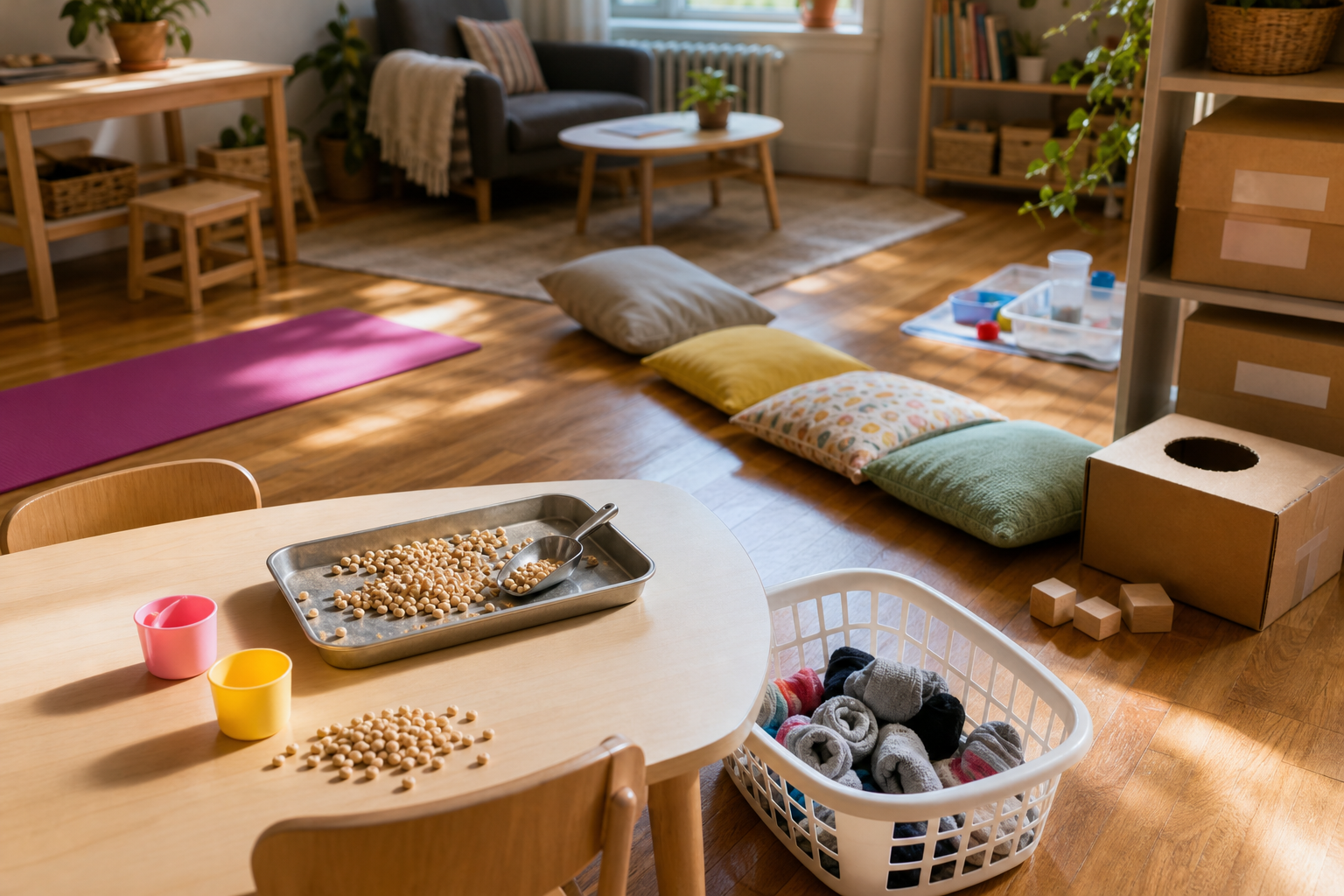
Fourteen setups sorted by stage, three shoebox kits to keep them in, and two places to go when the apartment runs out.
An indoor toddler activity is anything that gives a one- to three-year-old a real job for their hands or body while the weather keeps you inside. Most lists of indoor toddler activities NYC parents find assume a playroom, a backyard or a car. The ones worth keeping fit on one table or one rug, use what's already in the kitchen, and match your child's stage, because the tray that holds a fifteen-month-old will bore a three-year-old in under a minute.
Rainy Day Activities for Toddlers Who Are Still Learning to Sit Still
For children between one and two, the best rainy day activities for toddlers are short, repeatable and safe to put in a mouth. Give them a shallow baking tray, two plastic cups and a handful of the cereal or puffs they already eat. Pouring, spilling and scooping back up is the whole activity, and because the material is a snack, tasting is part of the game rather than a hazard.
Next, a laundry basket and a pile of rolled socks. Start the basket two feet away, then move it to four, then six. It looks like throwing practice, and it is also a child learning to aim and adjust, which is why it outlasts most toys with batteries.
The third is a cardboard box with one hand-sized hole cut in the lid and six wooden blocks beside it. Posting the blocks through, tipping the box out and starting again is a loop a thirteen-month-old can run without help. Keep every piece wider than a toilet paper tube. That's the common household check for anything a child this age might put in their mouth.
This is the age range our Little Pathfinders program serves, and its weekday rhythm follows the same pattern: short tasks, repeated, with an adult close enough to hand the cup back.
Toddler Fine Motor Activities That Use What Is in the Kitchen Drawer
Between two and three, children want to use their fingers the way adults do, which makes the kitchen drawer the best shelf in the apartment. The American Academy of Pediatrics points parents of toddlers toward blocks, empty containers, wooden spoons, shape sorters and puzzles. It also notes that simple, inexpensive objects are some of the best ways to support a child's creativity.
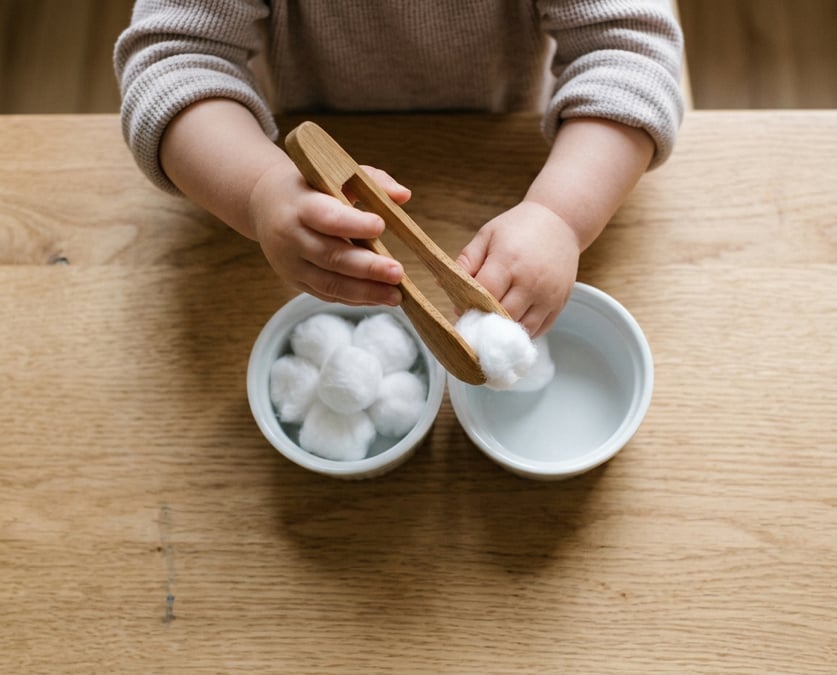
Start with salad tongs and two bowls, one full of cotton balls. Moving forty cotton balls from one bowl to the other uses the same squeeze-and-release that later steadies a pencil. The other toddler fine motor activities worth setting up take under a minute. Cut six slits in a yogurt container lid and hand over pipe cleaners to post through. Thread dry penne onto a shoelace knotted at one end. Or stick strips of masking tape along the table edge for peeling. Penne is small, so keep that one at the table with you.
What these four share is that the child can see whether they've succeeded without asking you. That built-in feedback is the test we apply to classroom materials in our Young Explorers program, and it's the thread running through how we teach through doing.
Expect the first attempt to be the shortest: a child who gives a tray ninety seconds on Saturday will often give it ten minutes on Sunday, because by the second run they already know what the materials do.
Sensory Play Ideas for a Small Apartment
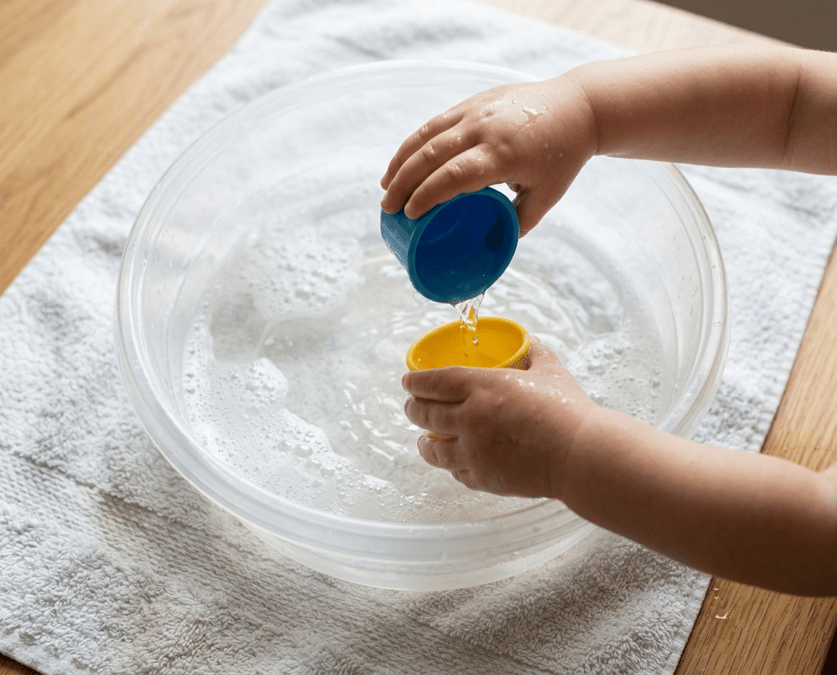
Sensory play ideas get skipped in city apartments because parents picture sand in the floorboards, yet the containable versions work just as well. Put two inches of warm water in a plastic dish tub on a bath towel and add a squirt of soap and four plastic cups. The cleanup is the towel.
For a dry option, half fill a zip-top bag with hair gel and a few large buttons, then put it inside a second bag. Tape all four edges flat to the table and let your child chase the buttons around through the plastic. Nothing escapes, and nothing reaches a mouth.
The third is a tray of dry oats with two spoons and a funnel, set on a bedsheet you can lift and pour back into the box afterwards. Oats sweep up more easily than rice and don't roll under the sofa.
End a sensory tray while your child is still interested. Stopping on a good minute makes them willing to come back to it the next wet afternoon, and it spares you the meltdown that comes when an activity runs until it falls apart.
Rainy Day Activities for Toddlers Who Need to Burn Energy
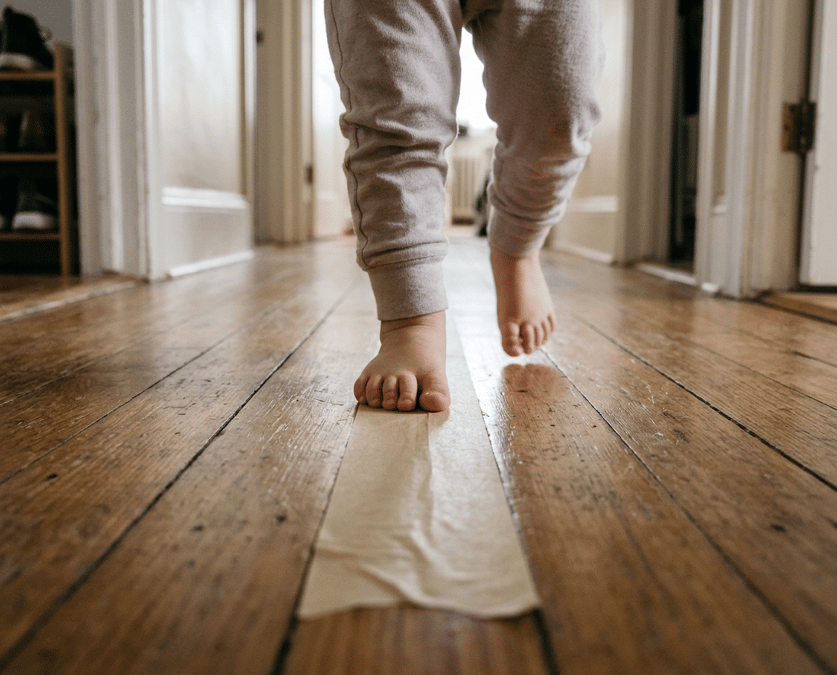
Trays solve half a rainy day. The other half belongs to a child who has been inside since breakfast. Run a strip of masking tape down the hallway floor and give three instructions in turn: walk the line, jump over it, then hop along it. Each round asks for a little more balance than the last.
Lay couch cushions flat on the floor in a path, never stacked, and let your child cross the room without touching the floorboards. Stand six empty water bottles at the end of the hallway as bowling pins and roll a soft ball at them. Put on a two-minute song for animal walks, switching between a bear crawl, a frog jump and a crab walk each time the chorus comes back.
A yoga mat or rug under the jumping keeps the family downstairs on your side. Do the movement games before the trays, since a child who has just moved hard settles into a quiet task far more easily. By three, children start inventing their own rules for games like these, and that's a big part of what our Rising Stars program for ages 3 to 5 builds on.
How to Keep Toddler Activities at Home Fresh All Season
Watch three shoebox kits get packed and played in under a minute: the dry transfer kit, the wet kit and the movement kit, each holding every material for the activities in this post.
The fastest way to wear out toddler activities at home is to leave them all out at once. Pack them into three shoeboxes instead, labeled so anyone in the house can grab the right one:
| Box | What goes in it | Best stage | Setup time |
|---|---|---|---|
| Dry transfers | Tray, cups, tongs, cotton balls, funnel, yogurt container with slits, pipe cleaners | 1 to 3 | Under a minute |
| Wet kit | Plastic dish tub, four cups, towel, sealed gel bag | 1 to 3 | Two minutes |
| Movement | Masking tape, soft ball, six empty bottles | 1 to 3 | Under a minute |
Bring out two boxes on a wet day and keep the third for the slow hour after lunch. A box that has been put away for a week feels new again. Families who keep the kits packed go from deciding to playing in about two minutes, and that's usually what decides how a wet afternoon goes.
These boxes are also your answer to the screen that's always within reach. The AAP's media guidance is specific: whatever the content, cap a child's electronic entertainment at one hour a day from eighteen months to age five. Two boxes will cover the gap at four in the afternoon, once that hour is used up.
Indoor Toddler Activities NYC Families Can Reach From Prospect Heights
For indoor toddler activities NYC offers beyond your own front door, two options sit close to our center at 979 Pacific St. The Brooklyn Children's Museum at 145 Brooklyn Avenue in Crown Heights welcomes ages six months to ten years. It's open Wednesday through Sunday from 10 am to 5 pm, and general admission is $15, with free entry every Thursday from 2 to 5 pm. Brooklyn Public Library's Central Library at Grand Army Plaza has a First Five Years area in its Youth Wing, with storytimes of songs, rhymes and stories for children from birth through five. Hours and programs change, so check both calendars the morning you go.
Playto serves Prospect Heights, Brooklyn (Prospect Heights, Crown Heights, Park Slope, Fort Greene, Clinton Hill, Bed-Stuy, Boerum Hill, Carroll Gardens, Windsor Terrace, Prospect Lefferts Gardens, and surrounding neighborhoods). You can see the rooms many of these ideas come from at our Prospect Heights center.
Pack the three boxes this weekend, before the forecast turns.
See Screen Free Activities for Toddlers on a Tour
If a wet weekend has you thinking about where your child spends the rest of the week, the screen free activities for toddlers in this post are the everyday stock of a Playto classroom. On a tour you'll see the shelves they come off and materials set at child height. You'll also see what a teacher does when a two-year-old walks away from a task after ninety seconds. Schedule a Tour at a time that works for you.
Toddler Activities at Home: What Parents Ask
What are good screen free activities for toddlers on a long indoor day?
Switch back and forth between a movement game and a hands-on tray. A tape line or bottle bowling burns energy, and a cotton ball transfer or water bowl calms your child back down. Songs count too, and music and early brain development explains why a repeated song does more work than it appears to.
What are good independent indoor activities for toddlers?
The best independent indoor activities for toddlers are ones your child has already done with you. Set it up, then sit nearby doing something of your own. Materials that show success on their own, like a bowl that fills or a box that empties, need less help from you. Creative play for older toddlers covers how this changes once a child passes two.
Which sensory play ideas are safe for a one-year-old?
They're safe when an adult sits beside the tray and every material is safe to mouth. Use food your child already eats, water, or sealed bags, and keep anything small enough to pass through a toilet paper tube out of reach. How we design sensory spaces shows the same thinking applied to a classroom.
What indoor toddler activities do daycares run when it rains?
Outdoor time moves indoors rather than disappearing, so expect movement games, music and hands-on stations, set up before children arrive. Weekday mornings are the best time to see it in person. If a visit is hard to arrange, you can take a virtual tour first.