October 23, 2026
How to Ensure Daycare Safety Today: What Safe and Snug® Checks
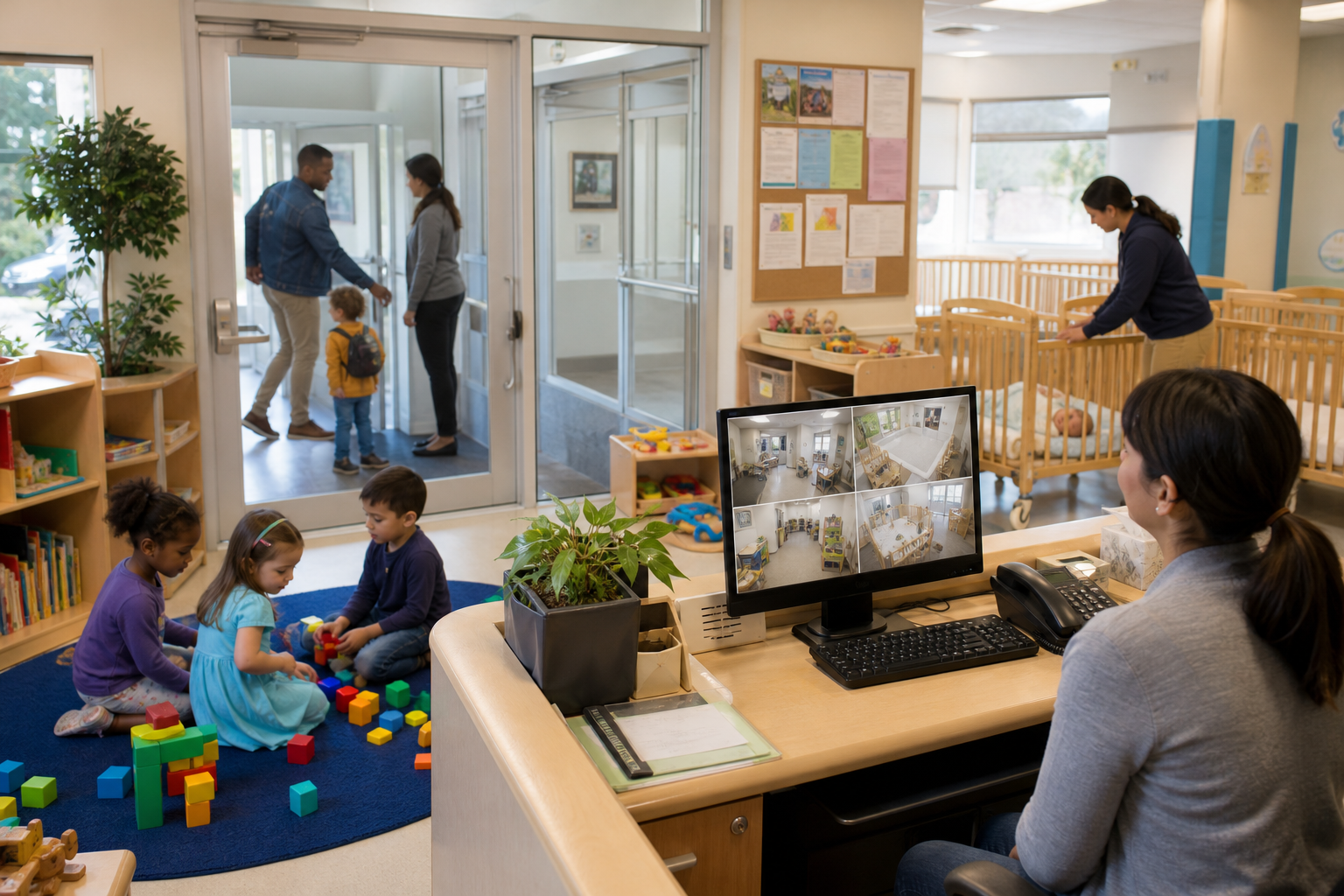
The specific checks behind the name, who is accountable for each one, and what you can verify yourself on a weekday morning.
Ever wondered what actually happens behind those locked daycare doors after morning drop-off? While shiny website claims offer peace of mind, knowing how to ensure daycare safety comes down to four critical, non-negotiable checks: secure access at the front entrance, infant sleep supervision, strict allergen management, and tight pickup verification. Here is how Safe and Snug® turns high safety standards into everyday practice at Playto—and exactly what you should look for on your next tour.
How to ensure daycare safety at the door you walk through
Entry runs on a double-door locked vestibule with controlled access points, a staffed front desk, and 360 degree closed-circuit camera monitoring. The daycare safety protocols at the door are deliberately slow, because the point of a vestibule is that nobody passes through two doors at once while a teacher is holding a toddler's hand.
Pickup is the mirror image. Sign-in and sign-out runs against a list of authorised names, and a change to that list goes through the parental app rather than a verbal message at the desk. Absences and pickup changes are logged in the same place, which means the person at the door is reading a record rather than remembering a conversation.
Cameras are a record, not supervision. The 360 degree closed-circuit monitoring exists so an incident has a reviewable account, and the front desk is staffed so that someone is watching the door in real time. Ask any center which of the two it leans on, because a camera nobody is watching is documentation after the fact.
Inside the classrooms, furniture and shelves are anchored, sharp edges are rounded or padded in the baby rooms, outlets are covered, window cords are out of reach, and floors are kept cord-free. Rooms are reviewed for choking hazards. You can read the full list on the safety, health and security page.
How to ensure daycare safety during sleep, meals, and pickup
Sleep is the check worth making first. Infants sleep in individual cribs or cots, are placed on their backs for every sleep, and are monitored at regular intervals. Around 3,500 babies in the United States die suddenly and unexpectedly while sleeping each year, according to the American Academy of Pediatrics, which is why a flat, bare, individual sleep surface is not a detail a center should be flexible about.
Food is the second. Allergies are recorded at enrollment, staff know each child's list, and preparation is separated to prevent cross-contamination. Nut-free, egg-free, gluten-free, dairy-free, vegan, vegetarian and kosher options are available, requested when a child enrolls rather than negotiated later, and the detail sits on the center's food and nutrition page. A daycare safety checklist that skips the kitchen has skipped the thing most likely to go wrong on an ordinary Tuesday.
Choking hazards get a standing review rather than a one-off sweep. Rooms are checked for small parts, window cords are kept out of reach, floors are kept cord-free, and electrical outlets are covered. These are the checks that stop being visible once they are done properly, which is why asking when the last review happened is more useful than looking around the room yourself.
The third is hygiene, which is unglamorous and does most of the work. Toys, surfaces and frequently touched areas are sanitised daily, handwashing stations use child-friendly soap, and diaper-changing stations carry their own sanitising solutions. Children in the Little Pathfinders room, aged one to two, touch everything and then touch their faces, so the cleaning schedule is a safety measure rather than housekeeping.
Who is accountable: how to ensure daycare safety through staff oversight
Daycare security is a staffing question before it is a hardware question. A locked vestibule only works if the person at the desk is looking up, and a sign-out list only works if the team knows the families well enough to notice a name that does not belong on it.
Supervision is continuous rather than annual. Caregivers clear a background check and a screening process before they are in a room, hold CPR and first-aid training, and work under ongoing supervision and evaluation afterwards. The practical test is whether a center can tell you who observed a given classroom last week and what they wrote down.
State daycare safety regulations set a floor rather than a ceiling, and the gap between the two is where centers differ. Playto makes no licensing or accreditation claim beyond what its own site publishes, so the useful move is to ask each center to show you the procedure rather than name the standard. Daycare safety standards described in a brochure and daycare safety standards running at 8:30am are not always the same thing.
Accountability is easier to test than to read about. Ask who checks the cribs during nap and how often. Ask who signs off that the allergy list in the kitchen matches the one in the classroom. Ask what happens when a parent arrives with someone not on the authorised list. A center that answers those three plainly, with a name or a role attached to each, is describing childcare safety that exists rather than childcare safety that was written down once.
The Battery Park City center is at 2 South End Ave, a short walk from Gateway Plaza and Rector Place, and serves families across Lower Manhattan who arrive on foot rather than by car. Its layout, including the vestibule and the nap rooms, is shown on the Battery Park City center page.
How to ensure daycare safety in Battery Park City and Lower Manhattan
Families using this center come from Battery Park City, the Financial District, Tribeca, Brookfield Place, Rector Street, the World Trade Center area, Fulton Street, South Street Seaport, Hudson Square, Civic Center, Bowling Green, Wall Street and Gateway Plaza. Because the neighbourhood sits behind West Street and almost everyone walks, the entry procedure at the door is the one families notice first and ask about most.
Because almost every family walks and many arrive inside the same ten minute window around 8:30am, the vestibule has to work under load rather than in a quiet lobby. That is worth seeing at the busiest part of the morning rather than at eleven.
The useful next step is to walk the route a stranger would have to take, from the pavement to a classroom, and see where it stops.
Daycare safety standards in practice: come and look
If you are comparing centers and have read three safety pages that sound alike, a weekday visit settles it. How to ensure daycare safety at a specific center means seeing the vestibule, the crib room and the sign-out desk in use, and asking the questions above while the day is running. Schedule a Tour when you are ready.
Questions parents ask about daycare safety regulations
What childcare safety questions should I ask at a Battery Park City center?
Ask how a visitor gets past the second door, who checks cribs during nap, how the allergy list reaches the kitchen, and how an unauthorised pickup is handled. Our post on the checks behind the classroom door sets out what good answers sound like.
Does the daycare safety checklist cover holidays and late pickup?
Yes. Teachers are available from 7:30am to 6pm with early drop-off and late pickup, the center stays open through the holidays, and the sign-out procedure is identical at 5:55pm and at midday. More detail sits in our write-up on everyday security policies.
Can I see the daycare safety protocols on a tour?
Tours run on ordinary weekday mornings, which means you see the procedures while they are being used rather than described. After the tour, enrollment and room availability are confirmed. Our post on when to keep a child home covers the health side families ask about next.
How do daycare safety standards change as a baby starts walking?
Once a child walks, the risks move from sleep and feeding to furniture, stairs and doors, so anchored shelves, padded edges and controlled access matter more than crib checks. Children also start learning the rules themselves, which our post on teaching safety skills to young children describes.