November 2, 2026
Daycare Age Groups: How Your Child Moves From One Room to the Next
The behaviors teachers watch for, the five visits that make up a room change, and the New York City rule that sets preschool age by birth year.
Daycare age groups are classrooms built around what children at one stage of development can do, with an age range attached as a guide. Playto runs four of them: Tiny Cruisers from birth to 12 months, Little Pathfinders from one to two years, Young Explorers from two to three, and Rising Stars from three to five. A child moves up when an ordinary week shows them doing the work of the room ahead, which is why two children born in the same month can change rooms several weeks apart.
Preschool Readiness Shows Up in an Ordinary Week
Every milestone on the CDC’s developmental checklists describes something at least 75% of children can do by that age, a standard the CDC and the American Academy of Pediatrics set when they revised the lists in 2022. On any given birthday, then, up to a quarter of children are still working on a particular skill. The CDC’s advice when a milestone is missed is to talk with your child’s doctor, and that same spread is why daycare age groups work best as a guide for teachers, with the child’s week deciding the move.
The table puts each Playto room beside what the CDC says most children can do by the time of the next move. These are the behaviors worth noticing at home, and they line up closely with what a teacher looks for before raising a move.
|
Room |
Ages |
By the next move, most children can |
|
Tiny Cruisers |
Birth to 12 months |
By 15 months: take a few steps alone, feed themselves some finger foods, and hand you a toy when you hold out your hand and ask for it |
|
Little Pathfinders |
1 to 2 years |
By 2 years: run, eat with a spoon, put two words together such as “more milk,” and play with more than one toy at a time |
|
Young Explorers |
2 to 3 years |
By 3 years: calm down within 10 minutes of a parent leaving at drop-off, join other children in play, use a fork, and put on some clothes on their own |
|
Rising Stars |
3 to 5 years |
By 5 years: take turns in games, stay with story time or a craft for 5 to 10 minutes, count to 10, and write some letters of their name |
Preschool readiness tends to announce itself in the Young Explorers room. The CDC lists following a two-step instruction, its example being “put the toy down and close the door,” at 30 months, and it is often the first sign that Rising Stars is coming into view.
Teachers record what they see over two or three weeks before raising a move, and you can ask to read the notes. A line saying your child followed a two-step instruction on four of five mornings gives you something specific to practice over the weekend. Space in the next room plays no part in the decision, and a place that opens with no child ready for it simply waits. Each room’s work is set out in the stage-by-stage curriculum, so you can read ahead to the room your child is heading toward.
Moving Into the Toddler Room Daycare Class, Day by Day
The move from Tiny Cruisers into Little Pathfinders asks a lot of a one-year-old at once: a louder room, more floor to cover, furniture at a new height, and a new set of adults. Playto spreads the change across five visits. The first is twenty minutes with the current teacher alongside, and the second runs an hour and includes snack. The third covers the morning and the start of lunch, the fourth adds nap, and the fifth is a full day in the new room with the old one still there if your child needs it.
Before the first visit, write the new teacher a short note covering five things: the word your child uses for water, how they show they are tired, what settles them after a fall, which comfort item comes to nap, and anything about meals you want kept the same. Your note gives the teacher a month’s head start. You get a short update at the end of each visit in the Playto Parental App.
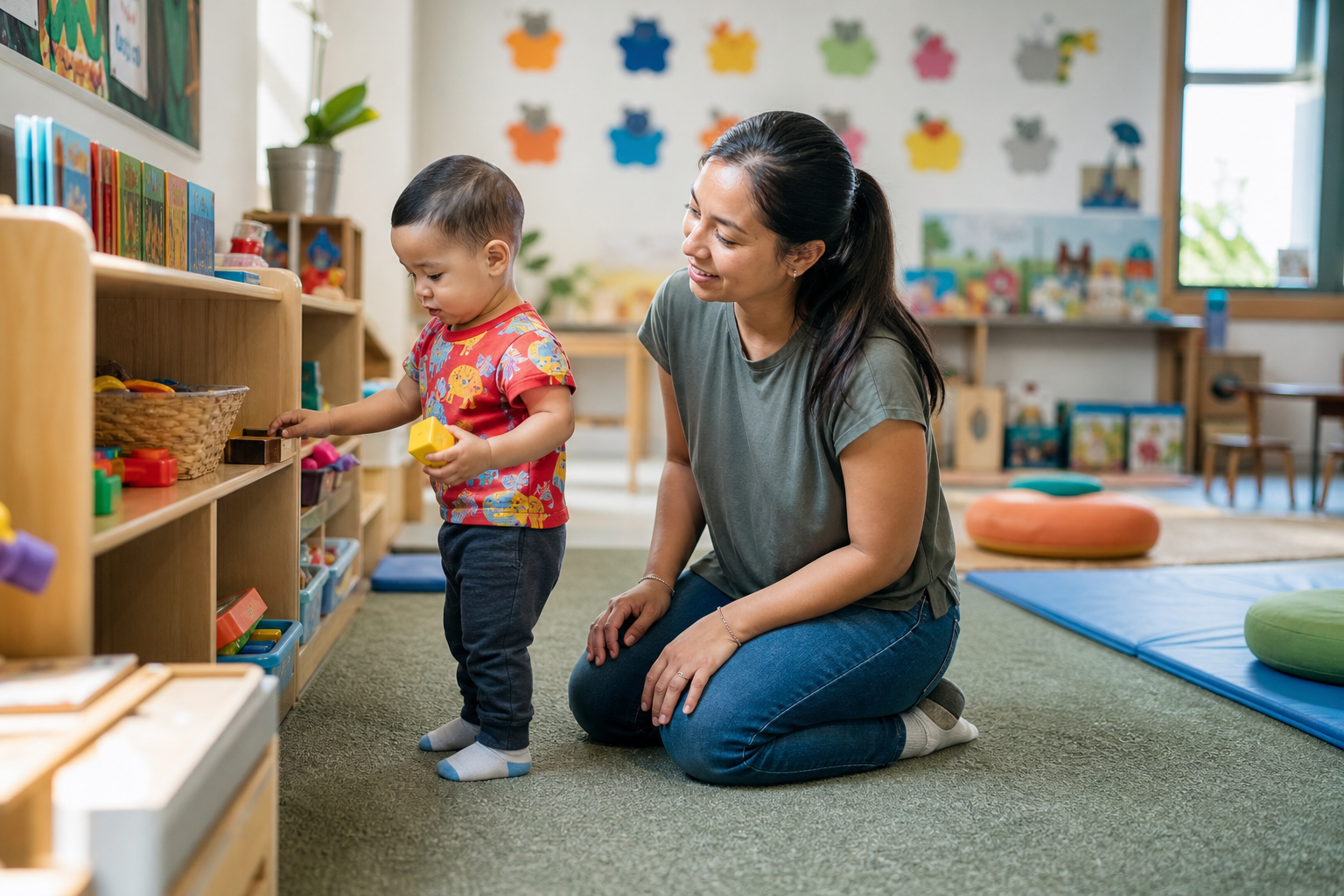
Image: teacher kneeling beside a toddler at a low shelf, shot from behind or hands only. Alt: Toddler choosing materials from low open shelves in a toddler room daycare class. Filename: toddler-open-shelves.jpg
Our Battery Park City center at 2 South End Ave sits a short walk from Rector Place and Gateway Plaza, so staying close by during those first visits is easy.
Separation behavior often returns during a move, usually in the form you first saw in infancy. Zero to Three notes that at seven to nine months a baby may sob and cling when a parent leaves the room, and a version of that response commonly comes back for a short stretch at each change of room. Much of what looks like lost progress in the weeks after a move is a child spending their energy on the new room.
For later moves, the CDC gives a useful yardstick: by three, most children calm down within 10 minutes of a parent leaving at a childcare drop-off. If tears at drop-off are still running well past that a few weeks into a new room, tell the teacher, who has seen those same mornings from the other side of the door.
What Changes in the Daycare Curriculum After a Move
Each room stretches the length of an activity. In the infant room the day is built from many short activities, each lasting about as long as a baby’s attention does. Group time joins the schedule in the toddler rooms, and by five most children can stay with story time or a craft for 5 to 10 minutes, the CDC’s benchmark for that age.
The daycare curriculum also moves from teacher-led to child-chosen. In the younger rooms a teacher brings the materials to the child. From two onward, materials sit on open shelves at child height and choosing becomes part of the work, which makes that shelf the quickest way to see the difference between two rooms on a tour.
Naps change on their own schedule, and this is the part families feel most at home. Two sleeps become one, the one shortens, and for some children nap becomes quiet rest. Bedtime often moves a little earlier for a few weeks while that settles.
Meals follow the same arc toward independence. A child who was fed at the table starts serving from a small bowl, pouring water from a half-filled jug, and carrying their plate to a trolley. The CDC lists serving food or pouring water with an adult watching among the things most four-year-olds can do, and the extra spills along the way are part of the practice.
Nutrition, the shape of the day, and how a comfort item is handled remain the family’s call in every room, so a move is a good moment to tell the new teacher what you want kept.
What Age Is Preschool in New York City?
In New York City public schools, preschool age is set by birth year. 3-K is open to children who turn three in the calendar year they start, and pre-K to children who turn four, both free and applied for through MySchools. For September 2027, that means 3-K for children born in 2024 and pre-K for children born in 2023.
A birth-year rule puts nearly a full year of development into one class. A child born in early January 2024 starts 3-K at three years and eight months, and a child born in late December 2024 starts in the same class at two years and eight months. Playto’s preschool-age work begins at three in Rising Stars, reached through the Young Explorers room, so a child with a late-year birthday joins the group whose work already matches their own.
Public preschool applications for next September open in the winter, so this autumn is a good time to ask your child’s teacher where they sit on the readiness table.
Daycare Age Groups in Battery Park City and the Neighborhoods We Serve
All four daycare age groups run at our Battery Park City center, so a child can start in Tiny Cruisers and reach Rising Stars in the same building. Playto serves Battery Park City, Manhattan (Battery Park City, Financial District, Tribeca, Brookfield Place, Rector Street, World Trade Center area, Fulton Street, South Street Seaport, Bowling Green, Wall Street, and surrounding neighborhoods).
Ask your child’s teacher which row of the table they are watching now, and you will know roughly how far off the next move is.
Preparing for Daycare Starts With Seeing the Next Room
If you are comparing centers, the rooms tell you more than any brochure. Standing in the room your child would start in, then in the one they would move to next year, shows you the shelves, the furniture, and the pace of the day they are growing toward. Bring three questions: how the last move from this room went, what the teachers are watching for at your child’s stage, and how you will hear about progress day to day. Schedule a Tour when you’re ready.
Questions About Preschool Readiness and Moving Up
How old are children in a toddler room daycare class?
At Playto the toddler years run across two rooms: Little Pathfinders for one to two years and Young Explorers for two to three. The ages are a guide, and a child moves between them on development, which the Little Pathfinders room page sets out alongside what a day at that stage includes.
Does the daycare curriculum change between rooms?
The method stays the same at every Playto center and every stage, while the materials, the length of activities, and how much the child chooses change from room to room. You can see its earliest version in how an infant day is structured.
What age is preschool compared with pre-K?
Preschool usually means the years from three to five, and New York City public schools split it into 3-K at three and pre-K at four, assigned by birth year. At Playto, preschool-age work starts at three in Rising Stars, with the groundwork laid in the toddler rooms, which how daycare prepares toddlers covers in detail.
What does preparing for daycare involve when a child changes rooms?
Mostly small practical changes: two spare sets of clothes instead of one, and a comfort item that may start coming out at nap. Meals, snacks, formula and diapers stay included at every stage, or you can keep bringing your own. Many families walk the rooms virtually first and save the in-person visit for the questions that come out of it.