November 16, 2026
Child-Led Play in Brooklyn: What It Looks Like in Our Classroom
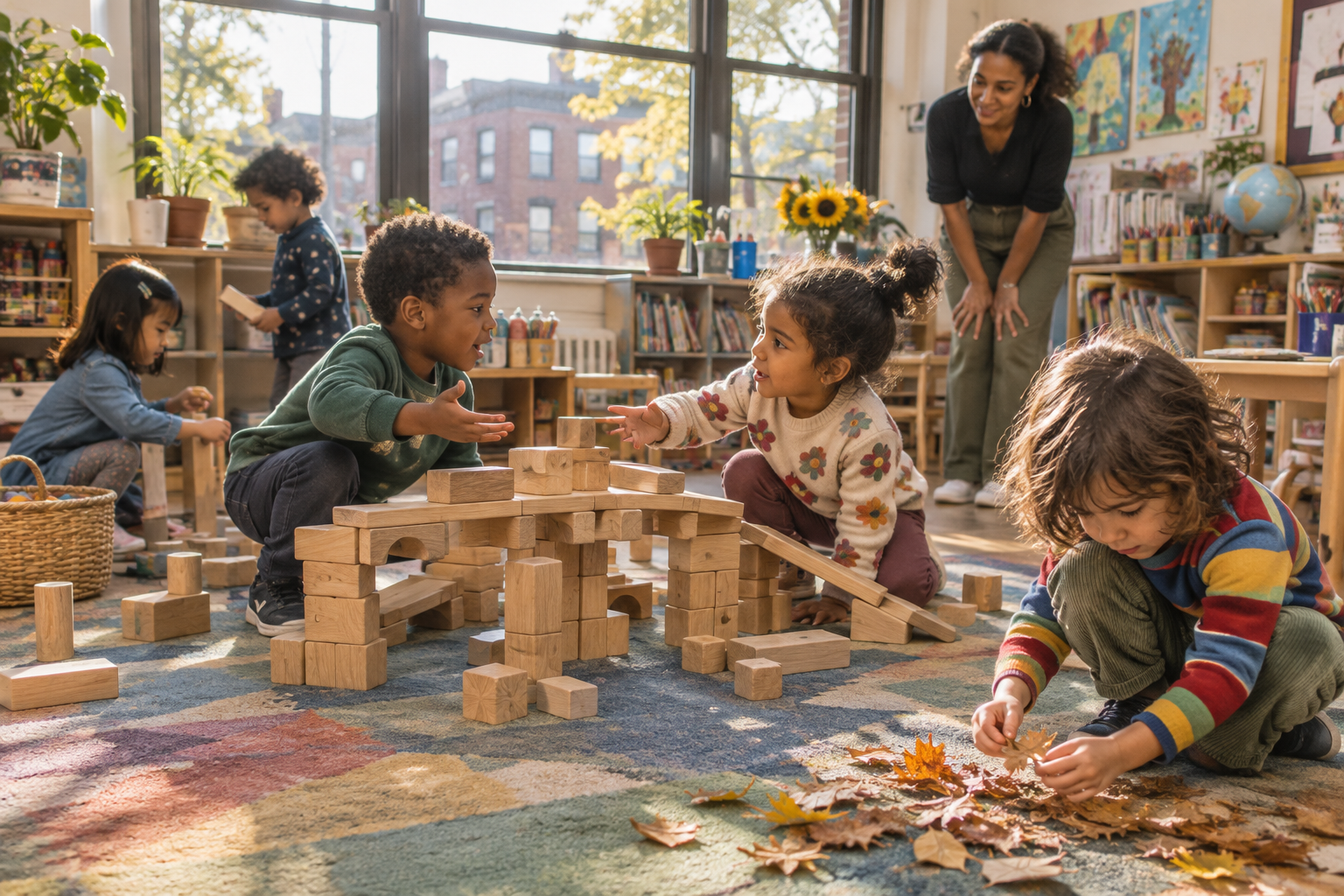
Child-led play is play your child chooses and directs. An adult stays nearby to support rather than steer. The UN Convention on the Rights of the Child names play as a right of every child. In a good early childhood classroom, that right looks like time, space, and materials for children to follow their own questions, both indoors and outdoors.
It is a Thursday morning on Pacific Street. Your four-year-old stops at the classroom door. Two children built a block bridge across half the rug, and they are arguing about whether it needs a ramp. Your child takes off a coat, drops it on the floor, and joins the conversation before you say goodbye.
Child-led play is any play in which the child decides what to do, how to do it and when it is finished, while adults set up the space and step in only to support.
What Is World Children's Day, and Why Play Sits at Its Center
World Children's Day is the yearly United Nations observance focused on the rights of children. It arrives this week. Article 31 of the UN Convention on the Rights of the Child sets out the right to play. It treats play as something every child deserves rather than a reward after work is done.
Early childhood educators take that right seriously. An article in NAEYC's journal Young Children argues that educators must position play as a key right. NAEYC's article on playful learning shows how this looks in a classroom. For parents, the main question is what this right looks like on a typical weekday.
At Playto, we build this answer directly into our method. We state that "learning is best when it's child's play." The MAGIC framework behind our approach to early learning starts by placing each child at the center and building curiosity.
What Child-Led Play Means, and What It Does Not
Child-led play does not mean adults step away completely. Instead, the child holds the idea while the adult holds the space. Teachers choose materials, keep children safe, and ask open questions. For example, a teacher who notices a collapsing block bridge might place longer wooden planks nearby, then wait for children to discover them.
This kind of play builds critical skills. The Harvard Center on the Developing Child notes that games and playful activities strengthen executive function skills. These mental skills support planning, focus, and self-control. Their guide to brain-building through play offers activity ideas by age for families to use at home.
Types of Play in the Early Classroom
Guided play sits between child-led play and structured lessons. An adult sets a loose goal, such as testing which ball rolls fastest, while children decide how to test it. Free play, guided play, and short adult-led moments all support growth, and a balanced day includes each type.
Unstructured play forms the broader category for child-led play. It includes any activity without a set outcome, such as dress-up or sandbox exploration. Through these open moments, children practice taking turns, resolving conflicts, and adjusting their plans.
Unstructured Play in a Rising Stars Classroom
For children ages three to five, unstructured play shows early learning in action. A pretend grocery store introduces counting and price tags. A block project introduces measurement and balance. A dispute over rules teaches active listening and empathy faster than a worksheet.
Preparing for Kindergarten
A strong preschool schedule mixes open play with short adult-led sessions. This balance gives children room to explore while preparing them for kindergarten. Our Rising Stars preschool classroom, for ages three to five, uses an experiential curriculum across every stage. Hands on. Minds in.
Pressure on play time affects older children as well. The American Academy of Pediatrics reports in its AAP power of play guide that roughly 30% of U.S. kindergarten children no longer have recess. This trend makes the preschool years an essential time to protect daily play.
[Image: a preschooler crouching to look at autumn leaves on a park path, seen from behind. Alt text: Preschooler examining autumn leaves on a park path during outdoor play in Brooklyn. Filename: outdoor-play-preschool-autumn-leaves.jpg]
Outdoor Play: Why Preschool Learning Belongs Outside Too
Outdoor play gives preschoolers experiences that indoor spaces cannot match. Children climb uneven ground, notice weather changes, and collect changing leaves. Experiential learning guides our work, and the outdoors offers rich hands-on discovery.
Learning in Prospect Park
In Prospect Heights, Prospect Park serves as an ideal outdoor classroom. Its open lawns, mature trees, and winding paths change across the seasons. A walk to track seasonal shifts or search for large leaves turns the park into a child-led learning space.
Prioritizing Outdoor Safety
Outdoor safety remains just as essential as outdoor time. We maintain safety standards through Safe and Snug®, our dedicated protection program. Our safety and security page details our procedures, including high staff ratios and secure checkout.
Play for the Youngest Children: Toddlers Lead Too
Child-led play begins in early infancy and toddlerhood. A toddler who repeatedly fills and empties a basket conducts a hands-on physics experiment. Adults support this learning best by letting the child complete the exploration.
Simple, open-ended materials work best for toddlers. Wooden blocks, fabric scarves, and water play allow each child to invent new games. Our Young Explorers toddler stage, for ages two to three, applies our experiential curriculum to this developmental stage. It focuses on building curiosity and self-confidence rather than finished products.
Our Prospect Heights center stands at 979 Pacific St, near Atlantic Terminal and the Barclays Center. Convenient transit lines connect the center to Prospect Heights, Crown Heights, Park Slope, and Fort Greene. Many parents stop here on their commute to Manhattan. View the center layout on our Prospect Heights center page.
Serving Families in Prospect Heights and Nearby Neighborhoods
Families access 979 Pacific St on foot, by stroller, and by subway across Brooklyn. We welcome children from Prospect Heights, Crown Heights, Park Slope, Fort Greene, Clinton Hill, Bed-Stuy, Boerum Hill, Windsor Terrace, Prospect Lefferts Gardens, Gowanus, Downtown Brooklyn, and Flatbush. Parents frequently choose this center because of its convenient placement along primary transit lines.
If this week has you thinking about how your child spends the day, the clearest answer is to see a classroom at play.
Schedule a Tour
If you are comparing centers in Brooklyn and want a classroom where your child leads the play, come and watch a real morning in the room for your child's stage and meet the team. Schedule a tour when you are ready.
Frequently Asked Questions
What is World Children's Day?
World Children's Day is an annual United Nations observance focused on children's rights. Article 31 of the Convention on the Rights of the Child establishes the right to play as a fundamental right. NAEYC's guide to play as a right explains how educators implement this right in early learning settings.
What is an example of child-led play?
An example of child-led play occurs when a child chooses to build a block bridge, selects materials, and tests the structure independently. The adult offers open-ended materials rather than step-by-step instructions. Review Harvard's brain-building play guide for additional age-appropriate ideas.
Why is play important for preschoolers?
Play helps preschoolers build essential executive function skills, including planning, self-regulation, language development, and peer cooperation. Explore how play-based learning structures our daily routine on the Rising Stars program page.
Is there a play-based preschool near Prospect Park open until 6 PM?
Yes, Playto's Prospect Heights center at 979 Pacific St offers daily hours from 7:30 AM to 6:00 PM with meals and snacks included in tuition. Get directions and view schedule details on the 979 Pacific St location page.
How can I see a classroom before enrolling?
You can schedule a tour to visit classrooms, meet teaching staff, and discuss enrollment availability. Reserve a tour time directly on the Playto contact page.
Related Reading
This post is general information about early childhood development, not medical or developmental advice. Children grow at their own pace. Talk with your pediatrician about any question specific to your child.*
Program details, hours, and availability change by center and by season. Confirm the current details for your center on a tour or with the Playto team.*